Tell us about the job
Takes about a minute. No obligation.
Sizing a central AC system for Grand Forks County starts from a question a contractor has to answer before anything else: what does this equipment spend most of its time doing? Homes in Grand Forks County, ND run cooling in a single month of the year, July. The compressor sits dormant through the rest of the calendar, and long idle periods corrode contactors, dry out capacitors, and leave faults that stay hidden until the first hot day of July. A contractor quoting an installation here specifies equipment and starting components with that failure mode in mind, not accumulated summer wear.
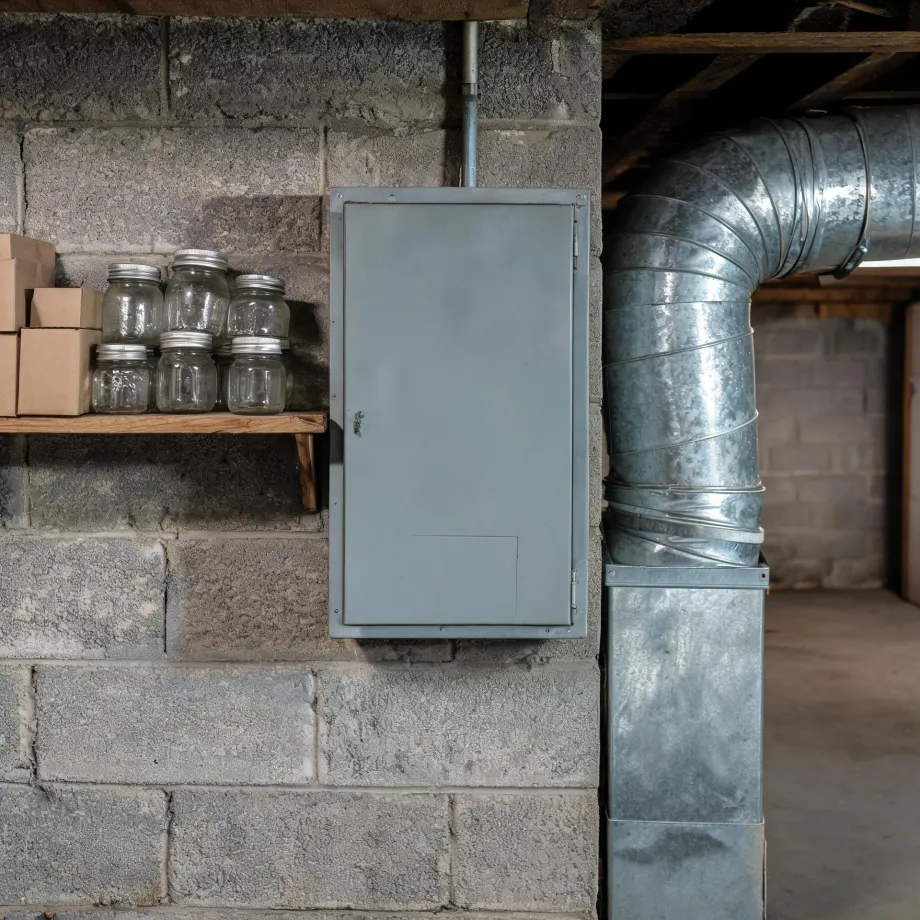
Ductwork laid out for a furnace-only system carries air differently than a central AC installation needs. Half the homes in Grand Forks County, North Dakota were built in 1982 or earlier (2020-2024 ACS 5-year). That means a contractor sizing a new unit here has to assess what the existing trunk lines and branch runs can actually handle before anything else on the job is priced or scheduled. If the duct geometry works, the installation moves forward on the equipment. If it does not, the ductwork becomes the job, and the new unit waits.
What a Central AC Installation Puts in Your Home
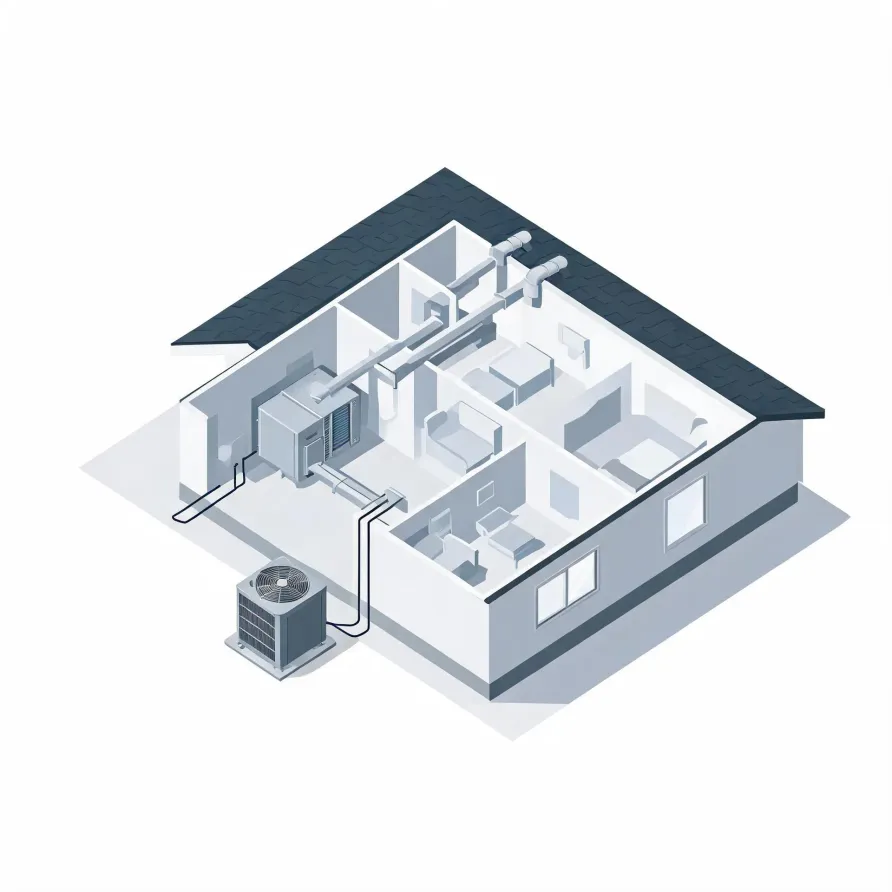
The outdoor condenser unit sits on a concrete pad beside the house and holds the compressor and condenser coil, the two components that shed heat collected from inside. The indoor air handler mounts in a utility space, attic, or basement and contains the evaporator coil, which is where warm indoor air gives up its heat to the refrigerant passing through.
A refrigerant line set runs between the two units, carrying refrigerant back and forth through insulated copper tubing that a contractor routes through walls or the attic. A thermostat mounts on an interior wall and serves as the control point, telling the system when to run and when to stop.
The drawing shows a typical layout, and a licensed contractor determines what the installation looks like in your specific home.
Find a contractor in Grand Forks CountyGrand Forks County, by the numbers
391 severe weather events were recorded in Grand Forks County, North Dakota between 2015 and 2024.
NOAA National Centers for Environmental Information, Storm Events Database, bulk CSV export, events 2015-01-01 through 2024-12-31.Half the homes in Grand Forks County, North Dakota were built in 1982 or earlier (2020-2024 ACS 5-year).
U.S. Census Bureau, 2020-2024 American Community Survey 5-Year EstimatesGrand Forks County, North Dakota holds 33,891 housing units (2020-2024 ACS 5-year).
U.S. Census Bureau, 2020-2024 American Community Survey 5-Year EstimatesOwners occupy 51.8% of the occupied homes in Grand Forks County, North Dakota (2020-2024 ACS 5-year).
U.S. Census Bureau, 2020-2024 American Community Survey 5-Year EstimatesCodes & Standards Governing Central AC Installation in Grand Forks County, North Dakota9 sourced rules and standards
What the installation looks like
Split-system central air conditioners rated below 45,000 Btu/h manufactured on or after January 1, 2023 must meet a federal minimum of 13.4 SEER2.
Split-system central air conditioners rated at or above 45,000 Btu/h manufactured on or after January 1, 2023 must meet a federal minimum of 13.4 SEER2.
Split-system central air conditioners manufactured between January 1, 2015 and December 31, 2022 had to meet 13 SEER, the metric that preceded SEER2.
Single-package central air conditioners manufactured on or after January 1, 2023 must meet a federal minimum of 13.4 SEER2.
Space-constrained central air conditioners manufactured on or after January 1, 2023 must meet a federal minimum of 11.7 SEER2.
Federal efficiency standards for split-system central air conditioners and heat pumps are set on each certified combination of outdoor unit and indoor coil rather than on the outdoor unit alone.
Residential and light commercial air conditioning and heat pump systems assembled in the field, including mini-splits and unitary systems, may not be installed on or after January 1, 2025 using a refrigerant with a global warming potential above 700.
A field-assembled system whose specified components were all manufactured or imported before January 1, 2025 carries no installation compliance date under the refrigerant restrictions and may still be installed.
Licensing and Legal Requirements in Grand Forks County, North Dakota
North Dakota requires a contractor licence once the cost, value or price of a job exceeds four thousand dollars, and an unlicensed contractor may not bring a claim or a lawsuit in a North Dakota court over the work.
Severe Weather Events in Grand Forks County
Weather puts measurable stress on heating and cooling equipment, and that stress is local. A system sized and installed for this county's conditions runs more reliably than one spec'd without that context.
391 severe weather events, 2015–2024. Source: NOAA National Centers for Environmental Information, Storm Events Database.