
How to get your AC ready for a North Dakota summer
After you send the request, you're done searching.
Getting your AC ready for a North Dakota summer means a handful of checks before the first warm week hits: clean or replace the filter, clear leaves and grass clippings away from the outdoor unit, and turn the system on early so you find out about a problem in May instead of during a 90 degree stretch in July. North Dakota summers don't carry the heavy humidity other places deal with, but the air conditioner still has to run hard on the hottest days, and a unit that sat idle all winter can have a dirty coil, a low refrigerant charge, or a capacitor that's weakened without ever failing outright. None of that shows up until the system is asked to work. Catching it before summer means a short visit and a quick fix instead of a breakdown on the one week you need it most.

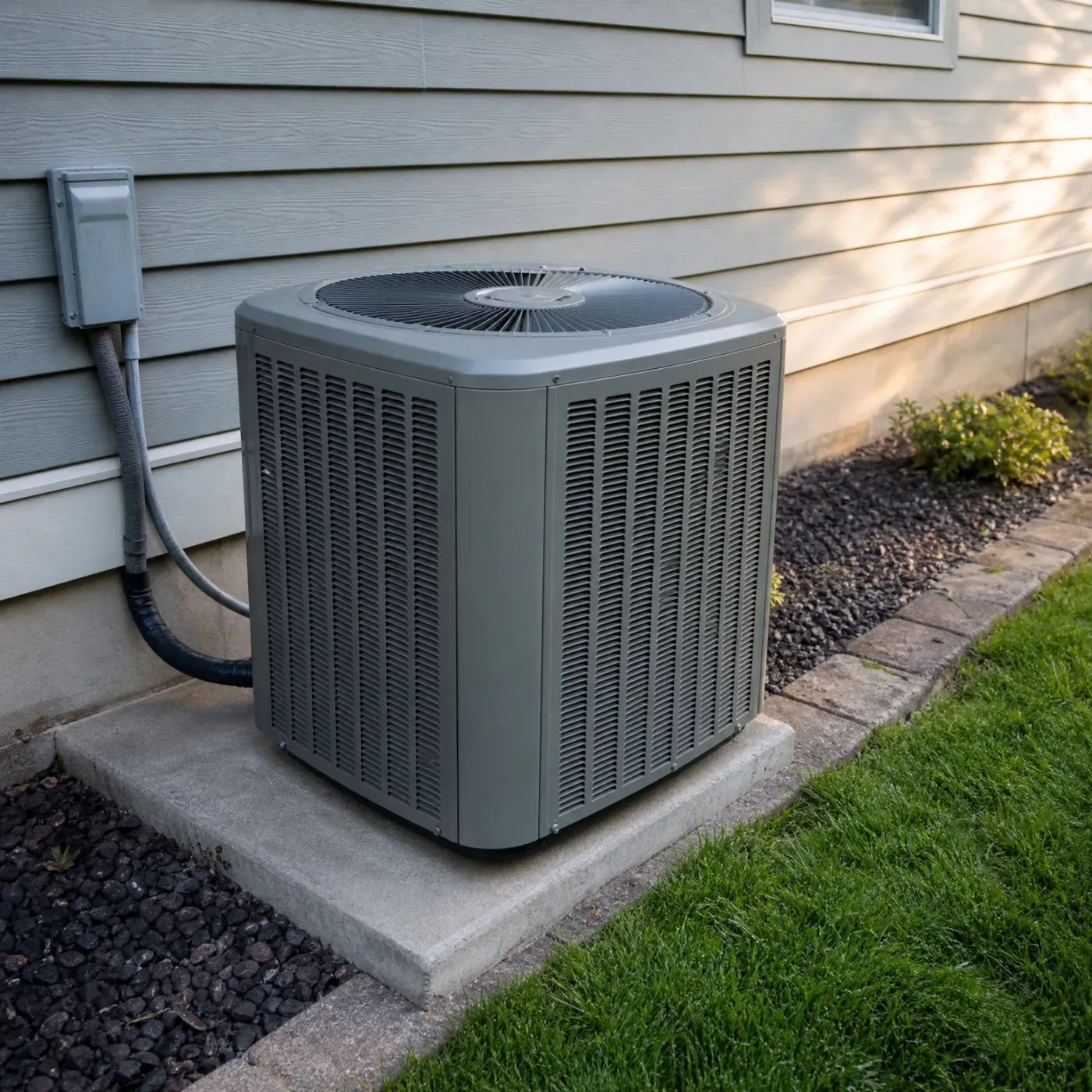
You're out coiling the garden hose in late May when you notice it, a haze of white fluff caught in the condenser fins, thick as a snowbank in miniature. The cottonwoods along the fence line have been letting go for days, and the breeze keeps pushing more of it against the unit. You crouch down and run a hand across the fins and they're packed solid, barely a gap for air to move through. The cabinet top has a dusting of it too, settled in the corners where the wind can't reach. You make a note to hose it down before you turn the system on for the first time this year.
Why does my AC blow warm air the first time I turn it on?
You flip the thermostat over to cool for the first time all year, expecting cold air right away, and instead you get a few minutes of warm or lukewarm air out of the vents before it finally cools down. You're not sure if that's normal or if something's wrong with the unit after sitting all winter.
That warm air at startup is usually just the duct air and the refrigerant settling back into place
Your system sat idle all winter while the furnace ran instead, so the air already sitting in the ducts is whatever temperature your house has been holding, and that's what blows out first. The outdoor unit also needs a minute to get the compressor running and refrigerant moving at full pressure. A few minutes of warm air before it cools down is normal. What's not normal is warm air that doesn't improve after ten minutes, or air that stays warm every time you run it after that. If that happens, it points to something like a low refrigerant charge or a compressor that isn't engaging, and that's worth having looked at before the first real heat wave instead of during one.

Thermostat calls for cooling and sends power to the outdoor unit
Contactor closes and the compressor starts pulling in refrigerant gas
Condenser fan pulls outside air through the fins to cool that gas
Refrigerant turns to liquid and travels inside to the evaporator coil
Is your AC actually ready, or just sitting there untouched since October?
Walk out to the unit. If the top and sides are packed with cottonwood fluff or last fall's leaves, air can't pull through the fins the way it needs to. Inside, pull the filter and hold it to the light. If you can't see through it, it's been too long. Flip the thermostat to cool on a warm afternoon and listen for the outdoor fan kicking on within a few seconds, and feel for cold air at the nearest vent within a few minutes. A unit that struggles to pull air through a blocked coil runs longer to cool the same house, and a system that runs longer wears out its parts sooner. None of this takes long to check, and none of it costs anything to look at.




Power costs 11.82 cents per kilowatt-hour statewide
At 11.82 cents a kilowatt-hour, running your AC in North Dakota doesn't punish you the way it does in some states. A dirty filter or a coil packed with cottonwood fluff still makes it work harder and run longer, so the checks are worth doing even with power this cheap.
EIA-861 2025 statewide residential average


One request and it's handed off

A licensed local pro takes the request for your air conditioner tune-up.
No fee to send it, and nothing to sign.
Why the fins matter so much
The condenser fins are thin aluminum, packed close together, and their whole job is to give the refrigerant enough surface area to dump heat into the outside air. When cottonwood fluff or grass clippings mat across them, the fan still spins, but far less air actually passes through. The compressor ends up working against that restriction, running longer to move the same amount of heat. Bent or clogged fins don't fail all at once. They just make the system run worse for longer, every day the dirt sits there. A straightedge comb can lift bent fins back into place, but packed debris has to be rinsed clear before the fins can work right again.
What a dirty filter costs the system
A clogged filter does the same thing in reverse, choking airflow before it ever reaches the indoor coil. Starved of air, that coil can drop below freezing and ice over, and once it's iced, it blocks airflow completely instead of just restricting it. The system keeps calling for cooling it can't deliver, and the compressor runs through a cycle that isn't moving much heat at all. A filter checked at the start of summer and swapped when it looks gray or packed costs you a few minutes. Letting it go costs the coil and the compressor the hours they spend working against it.


Where your AC stands now
- A clean filter and a clear condenser are what let your AC cool fast and shut back off instead of running long.
- Turning the system on before the first hot week gives a contractor time to fix a weak capacitor or a stuck contactor before you need the cold air.
- A local contractor who works on North Dakota systems all summer has seen what cottonwood fluff and grass clippings do to a condenser and knows where to look first.
- You send one request and hear back from one licensed contractor, not a string of calls from companies you didn't ask for.
- None of these checks need to wait until the air already feels warm coming out of the vents.
- Cheap power here doesn't cancel out what a dirty coil or a clogged filter costs you in runtime.
Most of what keeps a North Dakota AC running well comes down to things you can see for yourself. A filter either pulls air through clean or it doesn't. A condenser either sits clear or it's packed with cottonwood fluff and grass clippings. You've gone through what each of those does and why running the system early matters more than waiting for the first hot week to tell you something's wrong.
If something does turn up, a capacitor that's weak or a contactor that's starting to stick, you're not stuck calling around to find out who handles it. The contractor who gets your request works on this equipment all summer, in this state, through the same cottonwood season and the same dry heat you're dealing with. That's not someone guessing at what a fin-packed condenser does to a compressor. It's someone who's pulled fluff out of coils like yours before and knows what usually fails first when a system's been sitting untouched since October.
You send one request and it goes to that one contractor, licensed, local, not a list of companies competing for your callback. No second-guessing who's going to show up or whether they know this equipment.
Cheap power here means a sluggish AC won't wreck your bill the way it might somewhere else. It still means your system works harder than it needs to, runs longer than it should, and wears down faster than if the filter were clean and the coil were clear. Checking it now costs you nothing but a few minutes outside.
Done looking for an air conditioner pro
Your request goes to one pro, not a list of companies.
Sending the form costs nothing.