
ND Central Air

Why your AC outdoor fan isn't spinning in North Dakota

Step 1 of 3: Equipment

A fan that won't turn usually comes down to one of a few things. The capacitor that gives the fan motor its initial kick can weaken and fail, which is the most common reason. The motor itself can seize up after years of running outdoors through North Dakota winters and summers. A tripped breaker or a bad contactor can also cut power to the unit without you noticing anything else is wrong. Sometimes the fix is simpler: debris, ice, or a stuck blade is physically stopping it from turning even though the motor is trying to run. If the compressor is still running but the fan isn't, the unit can overheat fast, since that fan is what pulls heat off the coil. Left alone, that risk turns a contained problem into a compressor replacement, which costs far more than fixing the fan would have.

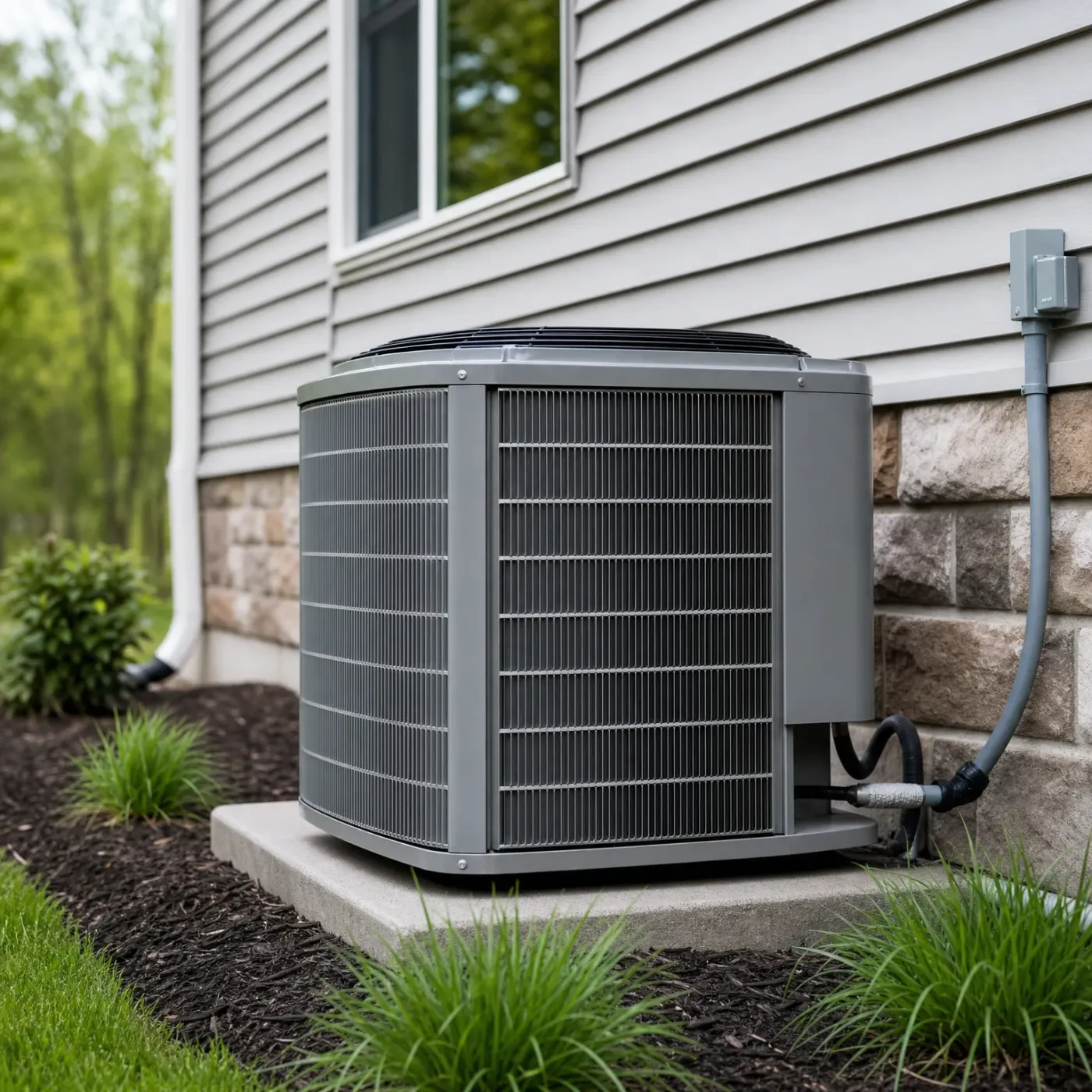
A gray outdoor air conditioner condenser unit on a concrete pad beside a house with horizontal lap siding, with a wall-mounted disconnect box and conduit to its right and shrubs to the left.

When the fan is doing its job

Air moves straight up off the top of the unit and you can hear the blade turning. The coil behind the guard stays clean enough to see the fins. Power to the disconnect box is steady, and the compressor isn't working harder than it has to.


An outdoor air conditioning condenser unit on a concrete pad beside a house with horizontal lap siding, with a conduit and electrical disconnect box on the wall at right.

When the fan has stopped

The unit hums or clicks but the blade doesn't move, or it stays dead quiet. Dirt has built up on the coil guard over the years outside. The compressor can overheat and shut itself off if the fan isn't pulling air through to cool it.

A man seen from behind raises his hand to wave at a woman standing in the open front doorway of a single-story house with gray shingle siding, white columns and a gabled porch entry.

What a stalled fan costs you if it waits

When that fan stops, the compressor is still running, still trying to move refrigerant, with no way to shed the heat it's pulling out of your house. On a warm North Dakota afternoon that system can overheat in minutes. Keep running it like that and you're not looking at a fan repair anymore, you're looking at a compressor, and that's the most expensive part in the whole unit.

You already know to catch things early, so shut the system off at the thermostat or the breaker once you notice the outdoor unit isn't moving air. From there, the next step is getting the right contractor out to look at it, one who works on the equipment you actually have, not a general call-around. Finding that, getting someone on the phone, explaining the symptom twice, that's the part you can skip. You answer a few questions about what you're seeing and a contractor who covers your area follows up with you directly.

A gray upholstered sofa with a textured cushion sits beside a dark round side table holding a vase of green foliage, with a table lamp and sheer-curtained window behind.
A gray outdoor air conditioner condenser unit on a concrete pad beside a house with horizontal siding and a light stucco wall, with a disconnect box and refrigerant lines on the wall and a shrub and mulch bed at left.

What the capacitor actually does

The capacitor stores a charge and releases it to the fan motor the instant the unit calls for cooling. That push is what gets the blade moving. Once it's turning, the motor can keep itself going, but a capacitor that's lost its charge can't deliver that first push at all. You'll sometimes hear the motor humming without the blade moving, which is the capacitor failing to do that one job.

A gray outdoor air conditioning condenser unit on a concrete pad surrounded by gravel, next to a white horizontal-lap-sided house wall with an electrical box and conduit, against a blank white background on the left.

Why dirt and debris matter

Cottonwood seed, cut grass, and winter grit settle into the coil and around the fan blade over a season outdoors. Enough buildup against the blade or the motor housing adds drag the motor wasn't built to push against. A motor that's otherwise fine can stall just from that resistance, the same way a fan with nothing wrong inside it can still refuse to turn if something outside is holding it back.

Why does my AC fan hum but not spin?

A humming fan usually means the motor is getting power and trying to start, but something is stopping the blade from actually turning over. It's a different problem than a fan that's silent, and it points to a different fix. You want to know what's holding it back before you decide whether it's safe to leave running.

The capacitor is too weak to start it, or the motor bearings have seized

That hum is the motor drawing power and trying to spin, but not getting enough of a push to break free. A capacitor that's lost most of its charge can still send some current to the motor, just not the jolt it needs to get the blade moving from a dead stop. The other cause is mechanical. Bearings that have rusted or worn down after seasons outside in North Dakota can bind the shaft so tight the motor just buzzes against it. Either way, the fan isn't moving air and the compressor is running without anywhere to put the heat it's pulling out of the house. It's worth shutting the system off rather than letting it hum.

A gray outdoor air conditioning condenser unit on a concrete pad beside a house with horizontal siding and a stone veneer base, with a wall-mounted disconnect box and conduit, next to a shrub bed and a concrete patio.

Unit running clean

This is a fan doing its job. The pad is clear, the disconnect box is dry, and nothing is blocking the louvers. Air conditioners that look like this tend to get a problem caught at the capacitor stage, before the compressor ever has to work without airflow.

An outdoor air conditioner condenser unit on a concrete pad beside a house with light gray vinyl siding, with a gray electrical disconnect box and conduit on the wall, gravel beds and dried plants nearby, and a concrete sidewalk in the foreground.

Unit left too long

Weeds and gravel don't stop a fan from spinning, but years outside without anyone checking in do. A unit this weathered has had more chances for a capacitor to weaken or a motor bearing to wear down, and nobody noticed until the fan went still.

A woman in a gray turtleneck sweater stands by a window looking outside at snowy ground, with a dimly lit living room containing a sofa, shelves, lamp and a lit candle behind her.
A woman in a cream cable-knit turtleneck sweater stands in a warmly lit living room with a fireplace and shelves behind her, looking out a window toward snow-covered trees and a railed deck.
A woman in a cream knit turtleneck sweater stands by a window looking out at snow, with a lit fireplace, sofa and lamp in the room behind her.
A woman in a gray knit sweater sits by a window looking out at falling snow, with a dimly lit living room containing a sectional sofa, pillows, a lamp and houseplants behind her.
A gray outdoor air conditioner condenser unit on a concrete pad beside a house with horizontal siding and a stone veneer foundation, surrounded by mulch, ornamental grasses, and shrubs, with a conduit and disconnect box on the wall.

A pro who works on air conditioners

Answer a few questions instead of calling shop after shop.

Tell a local repair pro what your air conditioner is doing.

Skip the calls

There's no charge for the request.

Fix the Fan Now or Risk the Compressor

Fix it now

  • A seized motor or dead capacitor gets caught and swapped before the compressor ever overheats.
  • The unit goes back to pulling heat out of your house the same day the part gets replaced.
  • A stuck fan blade or worn bearing is a small job on its own, not tied to anything else failing yet.
  • Catching it at the fan means the compressor never had to run without the airflow it needs to cool down.
  • A contractor can usually confirm whether it's the capacitor, the motor, or something blocking the blade in one visit.

Let it ride

  • The compressor keeps trying to run without the fan pulling heat off the coil, which is what it depends on.
  • A compressor that overheats repeatedly can fail outright, turning a fan repair into a full system replacement.
  • Every hot day the fan stays still is another day the compressor runs hotter than it's built to handle.
  • Once the compressor is damaged, there's no small fix left, just a bigger bill and a system down in the middle of a North Dakota summer.
  • Waiting doesn't make the capacitor or motor problem go away. It just adds the compressor to the list of what needs fixing.
  1. The thermostat calls for cooling and sends power to the outdoor unit.

  2. The capacitor releases its stored charge into the fan motor.

  3. That charge kicks the fan blade into motion.

  4. The motor takes over and keeps the blade spinning on its own.

A gray outdoor air conditioning condenser unit on a concrete pad beside a house with horizontal lap siding, with a conduit and electrical disconnect box on the wall and a green shrub in mulch to the right.
A clean unit like this one moves air freely, so the fan and compressor aren't fighting dirt or debris to do their job.
A weathered outdoor air conditioner condenser unit on a concrete pad beside a house with horizontal vinyl siding, with a conduit and disconnect box on the wall to the right.
Years of grime packed into the grille and leaves piled against the base choke airflow before the fan ever gets the chance to fail.
Single-story house with tan horizontal siding and a dark shingled hip roof, fronted by a patchy green and brown lawn and a concrete walkway leading to the covered entry.

Summer air in North Dakota doesn't carry much moisture. The dew point averages 53°F across June, July and August, which is what weather records show for where homes here sit. That's dry enough that your air conditioner isn't fighting humidity the way units do further south. But a stalled fan still leaves the compressor with nowhere to put the heat it pulls out of the house, dry air or not. You'll notice the unit running longer, the air coming out of the vents less cold, or the outdoor unit getting hot to the touch. The dry summer air doesn't protect a fan that's seized or a capacitor that's failed.

NASA POWER T2MDEW county cells weighted by homes

What you'd notice if your outdoor fan stopped

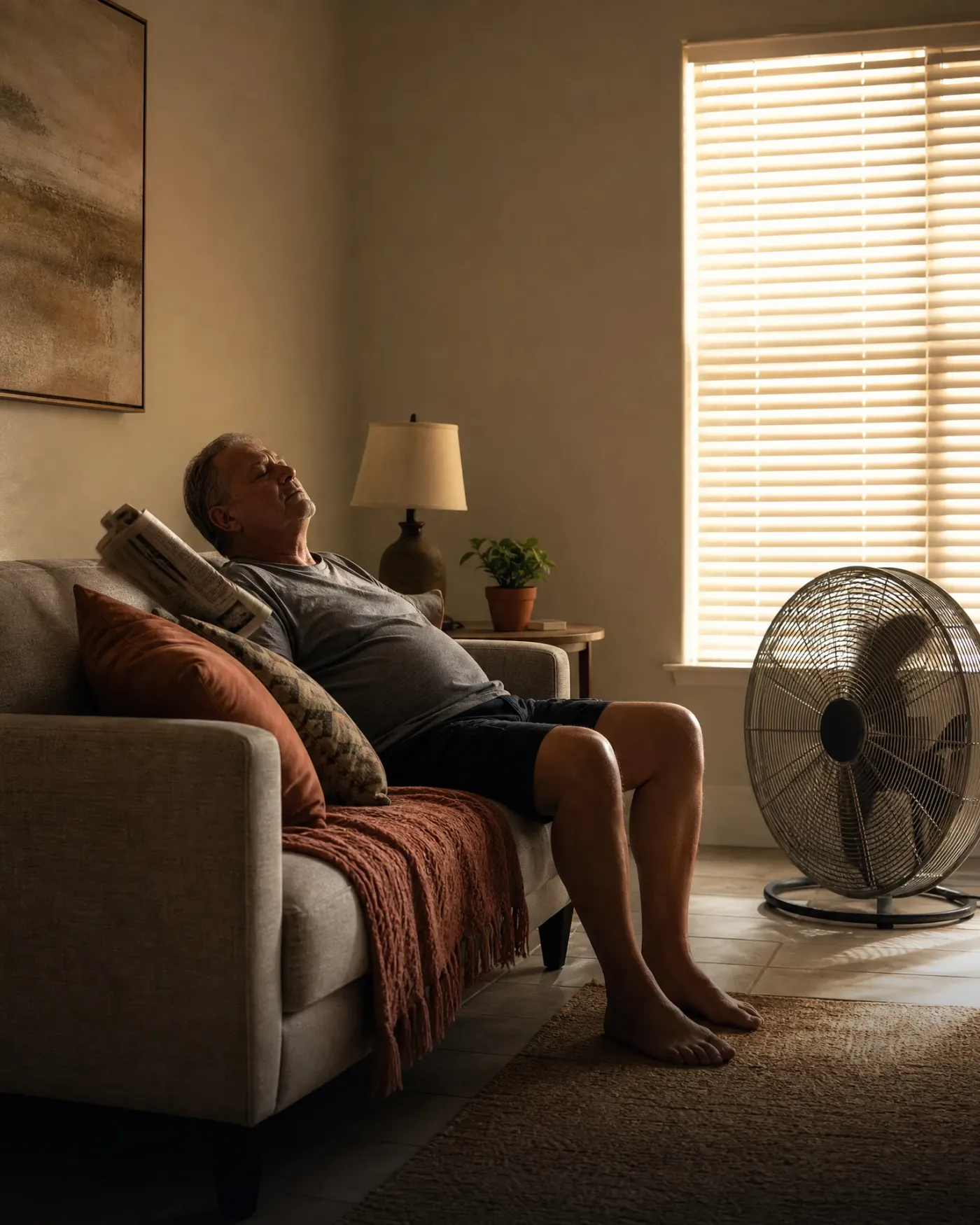
You'd likely notice the air coming out of your vents isn't as cold as it should be, or isn't cold at all. Go outside and look at the unit. If the fan blade isn't turning, you might still hear the compressor running, a steady mechanical hum from inside the cabinet. That's the sound of it working without the fan to help it dump heat. Touch the side panel and it may feel hot. If you catch this early and shut the system off, you've likely avoided any damage. Leave it running for a day or more with the fan stalled, and the compressor is the part that pays for it, since it's the most expensive component in the whole unit to replace.

A bearded man in a plaid flannel shirt stands in a kitchen looking out a window toward snow-covered shrubs, with a steaming mug on the windowsill and potted plants on a shelf behind him.
A smiling man with dark curly hair in a navy t-shirt sits on a gray couch indoors, with a large-leafed plant and a window in the background.

Call now and the fan gets checked before the compressor takes any more heat it can't shed. The capacitor or motor gets swapped, and cooling comes back the same visit.

Wait, and the compressor keeps running against heat it has nowhere to send. What started as a cheap part can end as a compressor that needs replacing, and that's a different job entirely.

Power costs 11.82 cents per kilowatt-hour statewide

Power here runs 11.82 cents a kilowatt-hour statewide, among the cheaper rates around. That means running your AC hard isn't what's hitting your wallet. A stalled fan is a repair bill waiting to happen, not a cost you're absorbing on the power bill while you put off the call.

EIA-861 2025 statewide residential average

Where this leaves you

  • A fan that won't spin almost always traces back to a weak capacitor or a seized motor, not something bigger.
  • Caught early, the fan gets swapped before the compressor spends another afternoon running against heat with nowhere to go.
  • Left alone, a stalled fan turns a small repair into a compressor problem that costs you more to fix.
  • You don't have to search out a contractor, make calls, or explain the same stalled fan to three different companies.
  • Matching with a contractor means one conversation instead of several, and the comparing and sorting is done for you.
  • Your AC is either moving air off the top of that unit right now, or it isn't, and that's the only question that matters.

Go look at the unit. If the fan blade is turning and air is moving off the top, you're fine. If it's not, you're dealing with one of two things: a capacitor that's lost its charge or a motor that's seized. Neither one is a mystery once someone's looked at it, and neither one gets better on its own while the compressor keeps running against heat it can't shed.

What usually eats up time with a problem like this isn't the repair itself. It's finding someone to do it. Looking up contractors, calling a few, explaining what the fan is doing and what it isn't, then doing that again for the next company because the first one couldn't get out this week. Getting quotes that don't line up and trying to figure out what they even cover.

Matching with a contractor skips that part. You explain the stalled fan once, to one contractor who already knows what they're walking into, and they reach out to you. No list of companies to work through on your own.

The fan is either spinning or it isn't. That's the whole question, and it's one you can answer by walking outside right now.

Interior room corner with sunlight from a window, showing peeling paint and damaged plaster on the wall above a white baseboard, a wooden cabinet with a pale bowl on top, hardwood floor and a patterned rug.
Interior corner of a room with tan walls, white profiled baseboard and window trim, a wood-plank floor in sunlight, and green foliage visible through the window.
An empty room corner with cream walls, white baseboard, two windows with deep sills showing green foliage outside, and a wood plank floor lit by sunlight.
Empty room corner with beige walls, white beadboard wainscoting, chair rail and baseboard, a window with green foliage outside, and sunlight casting leaf shadows on the wall above a wood floor.
Sunlit room corner with a multi-pane window, beige walls, white baseboard, wood floor with a woven rug, and a dark wooden cabinet holding a ceramic table lamp below a framed picture.

Get your air conditioner to the right pro

Describe your air conditioner job once, to one pro.

Answer a few questions

You only hire the pro if you want to.