













Why your upstairs stays hot in North Dakota summers

Step 1 of 3: Equipment

Why is it always hotter upstairs in my house in the summer?

You're probably used to it by now. The upstairs bedrooms sit a good ten degrees warmer than the living room, even with the thermostat set the same for the whole house. It's worse by evening, after the sun has had all day to work on the roof. You want to know if that's just how houses are, or if it's something worth having looked at.

Heat rises, and your system may not be sized to push cool air up against it

Warm air rises and cool air sinks, so the upstairs always takes the heat the downstairs gives up. Add a roof that's been absorbing sun all day, right above the second floor, and upstairs rooms end up fighting a losing battle against one thermostat trying to average the whole house. If your system has one return vent downstairs and little or none upstairs, it's not pulling that hot air out fast enough. A single-stage air conditioner that was sized for the whole house, rather than for how unevenly that heat actually lands, will keep running and still lose that fight on the hottest days. A technician can check whether your ducts and vents are actually moving enough air up there, and whether the system itself is keeping up.

A single-story gray horizontal-siding house with multiple front-facing gables, white-trimmed windows, a dark front door, and a concrete walkway crossing a partly dry lawn under a clear blue sky.

Summer air here isn't heavy. The dew point averages 53°F across June, July and August, which is dry enough that your air conditioner should pull heat out of the house fast. That's exactly why the upstairs heat stands out. With dry air, a system in good shape keeps every room close to the thermostat setting. When one floor still runs ten degrees hot, the air outside isn't the reason. It points to something in the system itself, maybe airflow that isn't reaching the upstairs rooms, or a unit struggling to keep up even with easy air to work with.

NASA POWER T2MDEW county cells weighted by homes

A smiling man in a navy long-sleeve shirt sits at a wooden table in a kitchen and dining area, with a ceramic mug, a potted plant, and a sliding glass door behind him.
A smiling bearded man in a green henley shirt stands at a kitchen island with a gray mug, looking off to the side, with a dining area and shelves blurred behind him.
A smiling bearded man in a navy sweater sits at a white kitchen island with a ceramic mug, with open shelves, potted plants and a range hood behind him.
A smiling man in a dark olive long-sleeve shirt sits in a kitchen beside a counter with a dark mug, with a dining table, sideboard and hallway visible in the blurred background.

Where the air actually goes

  • Heat rises through the house all day and collects against the upstairs ceiling with nowhere else to go.
  • One thermostat downstairs reads the cooler air near it, so the system shuts off before the upstairs catches up.
  • Ductwork in the attic picks up heat on the way to the upstairs vents, so warmer air arrives at the register than left the unit.
  • Supply vents upstairs often get less airflow than vents downstairs when a system was sized or balanced for the whole house at once.
  • A system that short cycles on a dry day cools the air but doesn't run long enough to push air through the longer upstairs duct runs.
  • Return air gets pulled mostly from downstairs in a lot of homes, so the blower is drawing cool air from the floor that's already comfortable.

Air conditioning works by moving air, and that air follows whatever path is easiest, not the path your upstairs needs. Cold air is heavier, so it tends to settle downstairs near the thermostat. That thermostat reads the temperature right around it and tells the system to stop once that spot is satisfied, whether or not the second floor has caught up yet. Meanwhile heat that worked its way up through the day is sitting against the ceiling up there with nowhere to go. If your ductwork runs through the attic to reach the upstairs rooms, the air picks up heat on that trip before it ever reaches the vent. So the register upstairs can be blowing air that's noticeably warmer than what left the unit, even though the system is running fine. A lot of homes were also balanced for the house as a whole rather than floor by floor, so downstairs vents get stronger airflow and upstairs gets whatever's left. On a dry day here, a system can cool the air fast and shut off before it's pushed enough of it through the longer upstairs runs. And because return air gets pulled mostly from downstairs in most layouts, the blower keeps drawing in air that's already cool, which tells the thermostat everything's fine. None of this means the system is broken. It means the air is doing exactly what the layout and the ductwork tell it to do.

An outdoor air conditioner condenser unit on a concrete pad beside a house with light gray horizontal siding, with mulch and green shrubs on either side and a concrete walkway in the foreground.
Before you get your air conditioner repair
A gray outdoor air conditioning condenser unit on a concrete pad beside a house with horizontal siding and a stone veneer base, with refrigerant line and electrical disconnect box on the wall and flowering shrubs to the left.
After you get your air conditioner repair

You already know the upstairs runs hot. What that means is the air conditioner is on longer than the thermostat downstairs lets on, because it shuts off reading cooler air while the rooms above are still catching up. That extra running time falls on the same parts every time: the compressor, the capacitor, the fan motor that cycles with it. None of that shows up as a problem you can see. It shows up as a system that's a little more worn each summer, until one afternoon it isn't there when you need it. You deal with small problems before they turn into big ones, and a ten degree gap between floors is exactly that kind of problem. It's not an emergency today. It's the reason you don't wait for one. Getting a contractor to look at what's driving the imbalance now means one call, one visit, one answer. Waiting means the same job later, plus whatever the system decides to take down with it on the hottest day of the year.

What the Heat Upstairs Costs You

  • The upstairs rooms running warm now means the air conditioner is working harder on the hottest afternoons than the thermostat downstairs ever shows.
  • A system that has to fight a hot attic and a single thermostat reading the wrong room wears down faster, especially the parts that cycle on and off.
  • Letting it ride through another North Dakota summer gives a struggling compressor or a weak capacitor more chances to fail on the day you need it most.
  • You already keep an eye on small problems, and an upstairs that is ten degrees off is the kind of thing worth having a contractor look at before it gets worse.
  • Fixing what's driving the imbalance now costs you one call instead of the back and forth of searching for someone, explaining the problem, and comparing quotes later.
  • Power here is cheap, but a system working overtime to cool a house it can't balance still runs longer than it should each day.
A smiling man in a dark blue T-shirt sits on a light gray sofa in a living room with a wooden shelf and window behind him, with a laptop edge visible in the foreground.
A bearded man in a plaid flannel shirt stands indoors looking out a frost-covered window, with a steaming dark blue mug on the wooden sill and snow-covered trees outside.

It's off your list after this

Skip searching for an air conditioner pro and answer a few questions instead.

You're not committing to anything by asking.

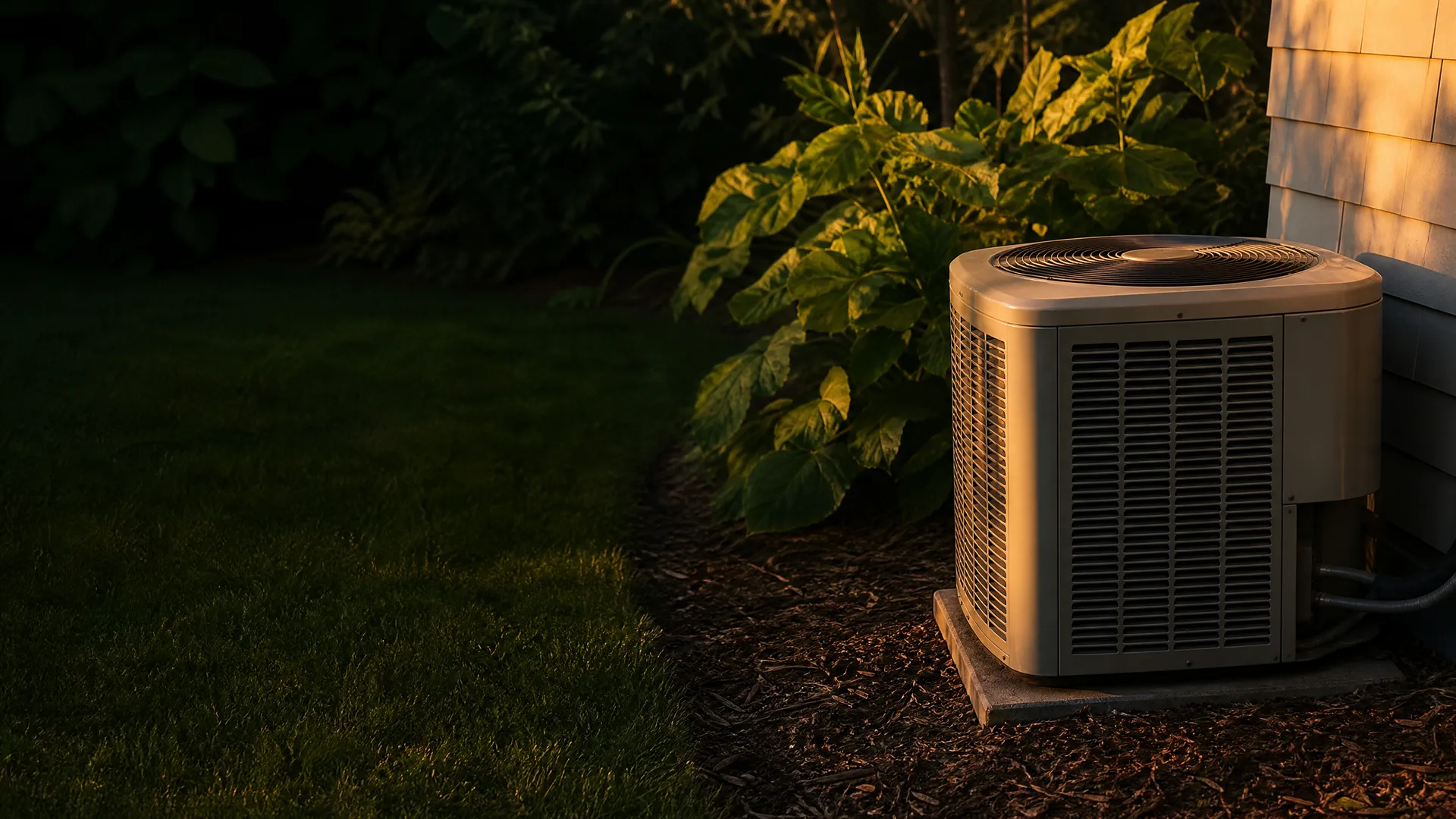
An outdoor air conditioner condenser unit sits on a concrete pad beside a shingled house wall, surrounded by mulch, broad-leaved shrubs and a lawn in low evening light.

You're out back around eight, still light out, the heat finally letting go of the air the way it does on a dry North Dakota evening. You walk past the condenser and notice the fan isn't spinning. No hum, no air moving off it, just the tick of the metal cooling. Inside, the downstairs thermostat still reads close to where you set it, but you already know the upstairs is holding onto today's heat with nothing pulling it out now. You crouch down and look at the fan blades, not moving, and the unit just sitting there in the low light.

A gray outdoor air conditioner condenser unit on a concrete pad beside a house with horizontal vinyl siding, surrounded by mulch, flowering shrubs, and lawn.
A clean condenser like this one can move heat out of the house at the rate it was built for, upstairs included.
A weathered outdoor air conditioning condenser unit on a concrete pad beside a house with light horizontal siding, an electrical disconnect box and conduit on the wall, and mulched soil on either side.
Dirt packed into the coil fins blocks airflow, so the unit runs longer and the upstairs rooms stay warm anyway.

What are you noticing upstairs right now

By mid afternoon the upstairs is noticeably stuffier than the rest of the house, and it stays that way into the evening even after the sun is down. You might notice the air feels still up there, or that the vents are blowing but nothing seems to change the room. Bedrooms are the worst of it, which makes for a bad night's sleep when it's already been a long hot day. If you check the thermostat downstairs, it looks like it's doing its job, which is part of what makes this confusing. Left alone, the system keeps running longer than it should to chase a temperature it can't fully reach, and that extra runtime is what wears on it over time.

A gray outdoor air conditioner condenser unit on a concrete pad beside a house with horizontal lap siding, with a wall-mounted disconnect box and conduit to its right and shrubs to the left.

Running the way it should

This condenser sits clean on its pad, conduit running neat to the disconnect box. Air moves through the coil fins without resistance. A unit like this can push enough cold air upstairs to close the gap with the rooms below, even on a dry 90 degree afternoon.

An outdoor air conditioning condenser unit on a concrete pad beside a house with horizontal lap siding, with a conduit and electrical disconnect box on the wall at right.

Falling behind

Dirt has built up on this one's coil guard, and it shows its age. Airflow through the coil drops as grime packs into the fins. The unit keeps running, but it moves less heat out of the house per hour, and the upstairs rooms are the first to feel it.

Power costs 11.82 cents per kilowatt-hour statewide

At 11.82 cents a kilowatt-hour, running the air conditioner longer to chase down that upstairs heat doesn't hit your bill the way it would in a lot of other states. The expense here is comfort, not cost. That's one more reason a stuck fan or a dirty coil is worth fixing instead of living with.

EIA-861 2025 statewide residential average

The upstairs heat isn't bad luck and it isn't something you have to live with. It comes down to a single thermostat reading the wrong room, an attic that bakes the ductwork, or a condenser outside that isn't pulling its weight. North Dakota's dry summer air should make this an easy job for a system that's running right. Once you know that, the next step is getting eyes on the actual unit, not more guessing from the living room. Instead of searching through contractors, calling a few, explaining the ten degree gap upstairs over and over, and sitting on quotes trying to compare them, you send the details once. From there, finding someone to look at it stops being your problem to carry. You've already done the hard part, which is figuring out what's actually going on above your head. What's left is getting a licensed contractor out to confirm it and fix it, and that part doesn't have to sit on your list of things to chase down.

Elevated view over a flat field with patches of snow, a bare deciduous tree at center, evergreen trees at both sides, and the shingled ridge of a roof in the foreground under a pale sky.

Hand off the search today

Skip the calls

It costs nothing to send, and you don't have to hire anyone.

Sending the request means you're done calling around and explaining the upstairs heat to one contractor after another. Someone licensed to find the actual cause, whether it's the thermostat, the attic ducts, or the condenser outside, takes it from here.